Photo shows two people's hands holding a tree sapling

Turning Knowledge into Action

Some people feel reluctant to take action on sustainability at work because they feel they haven’t got their own lifestyle “perfectly sorted” yet. You don’t need to be perfectly sustainable to make a difference - this is about collective progress.

Nonetheless, personal actions are important and can help inspire collective action amongst friends and family. Imagine the impact if all NHS staff took the actions listed below! Culture change turns action into normality.

Personal actions

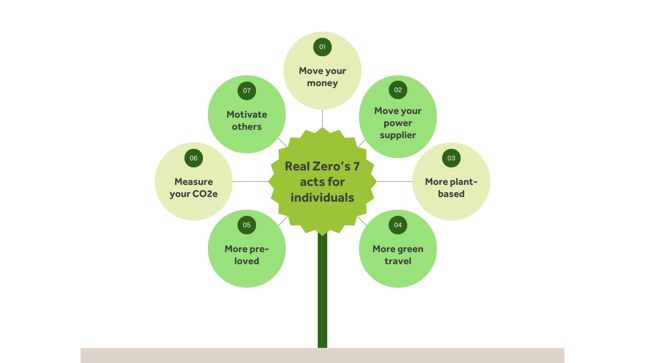
Commit to Real Zero’s 7 acts to make an individual difference 

  1. Move your money  - to a bank that does not invest in fossil fuels
  2. Move your power supplier – to a 100% renewable source  
  3. More plant-based – choose food that can sustainably feed the global population without destroying land & biodiversity, and create and protect green spaces
  4. More green travel – reduce flying, and choose trains or video conferencing, reduce car use and choose public and active travel options
  5. More pre-loved – reduce consumption and waste, buy less, re-use, repair and recycle
  6. Measure your personal CO2e – to motivate you to make changes
  7. Motivate others – talk about changes you make and encourage others to commit to these 7 acts, use your voice and your vote to demand action on climate change 

More ideas: 

Not every action will be accessible to everyone right now, but small, regular progress adds up over time. Some steps, like active travel and eating more plant-based food, can also bring immediate and lasting health benefits.

Clinical practice

Key actions for sustainable respiratory care practice

  • Incorporate prevention into routine clinical care
  • Review patient pathways to identify waste and poor care co-ordination to improve efficiency and patient experience
  • Choose low carbon medications and technologies wherever possible
  • Support and empower patients to self-manage
  • Work collaboratively to ensure long term change  

Prevention is one of the pillars of sustainable healthcare. Incorporating prevention into all stages of patient care is good clinical care and is within the competence of every healthcare professional.

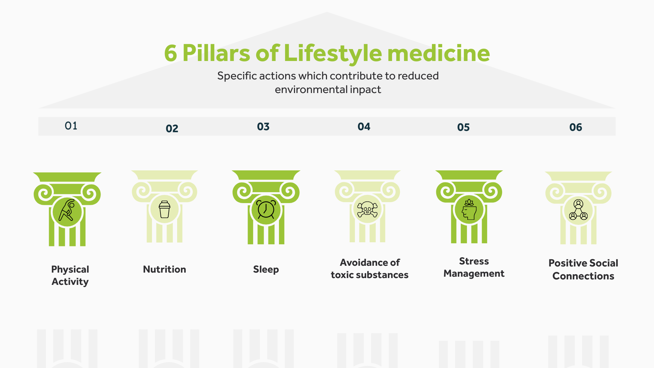
Lifestyle medicine is a way to structure and apply evidence-based approaches to prevention for all patients.

Pillar Action

Physical Activity

Nutrition
  • Include nutrition education in Pulmonary Rehab, patient talks and webinars
  • Signpost to evidence-based sustainable diet advice eg the Eat Lancet Planetary Health Diet
  • Refer under and overweight patients to a dietician
  • Connect with voluntary and third sector groups who provide cooking classes or veg vouchers
Sleep
Avoidance of toxic substances
  • Provide support to stop smoking
  • Prescribe medication to treat tobacco dependence
  • Provide advice on minimising exposure to air pollution 
  • Signpost parents and teachers to information on school streets
Stress management
  • Screen for anxiety and depression (pre-clinic digital questionnaires)
  • Signpost to support and refer via IAPT
  • Help patients understand the connection between mind and body 
Positive social connections

Interventions to reduce exacerbations in specific patient groups are based on providing the best clinical care: this may include:

  • treating tobacco dependence
  • macrolides in bronchiectasis or COPD patients with frequent exacerbations
  • biologics in severe asthma,
  • immunosuppression or antifibrotics in ILD.

High-quality proactive clinical care that prevents disease is also low-carbon care. 

Many current healthcare pathways and ways of working are inefficient and wasteful. Lean care pathways eliminate waste in resources, energy, and time to improve efficiency, reduce the carbon footprint and plastic waste, and ensure economically viable services that promote both patient and staff well-being.

The GIRFT (Getting It Right First Time) programme is not explicitly a sustainability programme, but it provides a wealth of data and ideas on best practice. 

Other examples of opportunities to implement lean pathways are shown in the table below

Opportunities to implement lean pathways

Theme Opportunities
Guidance 


  • Co-created guidelines with ED teams eg on asthma care & follow-up
  • Promotion of national guidance eg BTS Asthma Attack Bundle 2024
  • Clear local pathways for common conditions to prevent unnecessary admissions eg pleural effusion, pneumothorax, outpatient PE management (all based on BTS guidance)


Diagnostics
  • Triage of referrals and booking lung function tests for the same day as a clinic appointment 
  • Eliminating unnecessary/duplicate investigations 
  • Reducing single-use items 
  • Diagnostic hubs with access to eg FeNO outside the hospital
Integrated care/ closer to home
  • Community MDTs 
  • Working with community pharmacies and primary care networks (identify and address SABA over-reliance, coach inhaler technique, address adherence)
  • Access to specialist advice to prevent need for referrals (eg advice and guidance, consultant on call for community team/GP advice)
Follow up
  • Patient initiated follow up
  • Risk stratified follow up
  • Clear criteria for discharge to GP from chronic disease clinics 


Digital transformation
  • Virtual clinics & MDTs 
  • Virtual Group consultations 
  • Electronic questionnaires (eg for PROMS) 
  • AccuRx for text message communication with patients
 
Unplanned care
  • Walk in appointments/Hot clinics for Resp patients 
  • Support phone line/email for patient advice 

The priority for any patient on inhalers is that their disease is well controlled. This is best achieved by following the latest NICE/BTS/SIGN and local guidelines. Here are some key considerations when focusing on environmental sustainability.

Reducing gas-related emissions and devices

Accurate Diagnosis 

  • Asthma is frequently over-diagnosed; de-escalation of unnecessary asthma treatments reduces waste and helps patients avoid side-effects.
  •  Bronchodilators are often prescribed, but are ineffective for symptomatic smokers or ex smokers who don’t have airflow obstruction on spirometry
  • Inhaled steroids only benefit a subset of patients with COPD (those who have exacerbations and higher blood eosinophils), but patients with severe disease are often escalated to inappropriate high-dose ICS

Medication and Device

  • Make sure your hospital has a range of DPI and MDI options available, so the right device can be made available.
  • Consider whether you or your department need to work on inhaler technique knowledge and skills.
  • Every patient should have inhaler technique assessed, the right device selected in a shared decision-making approach, and ongoing support to maintain optimal technique.
  • For asthma, choose SABA-free regimes (AIR/MART) for appropriate patients, and prioritise a DPI, LABA/ICS where patients can use these devices effectively
  • Recommend DPIs and SMIs over MDIs whenever patients can use these devices effectively
  • For patients on a stable dose using MDI, review whether fewer puffs of a higher dose inhaler can be used (maintains dose delivered but reduces propellant use)
  • Choose the lowest environmental impact inhaler among suitable devices
  • Prioritise devices with an integral dose counter 

Propellant 

  • Avoid inhalers with the highest carbon footprint due to use of HFA-227ae as the propellant (Flutiform MDI and Symbicort MDI). In most cases a suitable alternative is available.
  • For patients remaining on MDIs, choose low-carbon MDIs as they become available. The first low-carbon pMDI using an HFO-1234ze(E) propellant was approved for use in the UK in 2025 (Trixeo)
  • For patients remaining on SABA MDIs choose those with a low volume of propellant (Salamol or Airomir) over those with high volume (Ventolin) 

Oxygen

  • Piped “wall” oxygen is cheaper and has a lower carbon footprint than O2 from cylinders.

Look around at your department, and accepted norms. Start asking questions and challenging the rationale for current practice.

  1. Audit – map your current practice (number of ABGs, repeat allergy or Quantiferon tests, bronchoscopy or pleural  kit waste, glove usage, O2 left running)
  2. Prioritise high-waste areas with low/minimal clinical value. Apply Choosing Wisely principles
    eg No routine bronchoscopy for haemoptysis or Unnecessary ABGs in COPD patients
  3. Intervene – Follow ABG guidelines,   don’t open things “just in case they’re needed”, re-use of MDI inhalers in the lung function lab (see QI section), explore recycling options
  4. Evaluate and share – measure waste avoided, convert to CO2 or money saved where possible, share success.


Advocate for clean air 

  • Hold a clean air day event  
  • Start an anti-engine-idling campaign   
  • Propose that air pollution is added to your trust’s risk register, so that your trust is made aware of, and takes action to tackle, the risk that air pollution presents to staff, patients and visitors on your hospital site. Develop a Clean Air Plan like Guy's and St Thomas' hospital.
Good practice example: King’s College Hospital and Guy’s and St Thomas’ Hospital have a joint Clean Air Plan, in addition to their Trust Green Plans.

Communicating with patients

Effective self-management helps patients maintain control of their own disease, fosters confidence and independence, could help prevent complications by intervening earlier, and hence reduces the environmental impacts of care.


Key components include

  • Education and Skills: Providing clear, personalised information about their condition and its treatment.
  • Peer Support: Fostering connections with others living with similar respiratory conditions for shared experiences and motivation.
  • Action Plans: Co-created, personalised plans for recognising and responding to worsening symptoms.
  • Family and Carer Involvement: Engaging support networks to reinforce self-management strategies.
  • Breathlessness Management Techniques: Teaching pacing, breathing exercises, and relaxation methods.
  • Digital Technology: Using apps like myCOPD and online resources to support learning, monitor symptoms, and track progress.
  • Timely Access to Help: Ensuring patients know how to seek professional advice promptly when needed.

Since animal agriculture is a significant contributor to air pollution (90% of UK ammonia emissions are from poultry and pig farms, and up to 30% of PM2.5 in UK cities is from agriculture) adopting a more plant-rich diet at a population level will lead to reduced exposure to air population for patients.

A healthy, plant-rich diet may help reduce inflammation, support immunity, and maintain a healthy weight—factors that are important for lung health. Reducing processed foods and eating more fibre-rich fruits, vegetables, legumes, and whole grains can make a big difference.


Communicating about diet

Diet resources

Do you provide your patients the best possible support to quit smoking?

Become a qualified smoking cessation advisor by taking the free course on the National Centre for Smoking Cessation website 

Does your hospital provide the best possible support to quit smoking?

Implement the recommendations in the BTS Tobacco Dependency Toolkit

Exploring air pollution with patients

Ask

  • about triggers/possible reasons for uncontrolled asthma before adjusting medications, including environmental factors (for example air pollution, indoor mould exposure).

Advise

  • that indoor and outdoor pollution can worsen symptoms and trigger exacerbations
  • that there are actions people can take to reduce exposure 
Air pollution can worsen breathing conditions such as asthma and COPD. You may notice more symptoms on days when pollution levels are high. We encourage you to check local air quality forecasts so you can take steps to protect yourself.

Information to share with patients

Vaccination is a high value intervention for all patients living with respiratory disease as it reduces the risk of severe exacerbation.

Useful resources to promote vaccine uptake are available from the UK Health Security Agency.

I’ll share a link to information on this from health experts.

Empower, don’t overwhelm: share positive actions they can take.

Some inhalers have a much smaller carbon footprint than others, if that’s something that is important to you.

Use existing tools: e.g. Asthma + Lung UK patient leaflets, NICE inhaler decision aid.

The most important thing is that your disease is well controlled. That’s best for you, and also has the lowest impact on the planet.