

Applying to respiratory medicine
Quick links
- Considering a career in respiratory medicine
- Applying to respiratory medicine
- Application form
- Self-assessment evidence
- Application scoring
- The interview
- After the interview
Considering a career in respiratory medicine
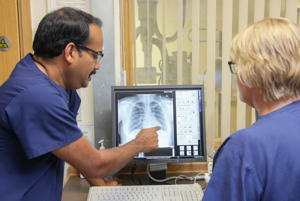
Respiratory medicine is a diverse and rewarding specialty, offering opportunities to work across a broad range of clinical areas. The path to becoming a consultant in respiratory medicine involves completing specialist training as a respiratory medicine registrar, usually following core medical or internal medicine training.
If you are considering a career in respiratory medicine, speak to the respiratory team at your local trust. Registrars and consultants can offer valuable insights into the specialty, share their experiences and help you explore opportunities to get involved in projects that can support your application.
Want to find out more about a career in respiratory medicine?
Read the British Thoracic Society's (BTS) career guide to explore the training pathway, career opportunities and what it's like to work in the specialty.
Visit the Physician Higher Specialty Training (PHST) Recruitment website for further information about applications and recruitment.
Applying to respiratory medicine
Applications for respiratory medicine specialty training are submitted through the NHS Oriel website. It is worth visiting the site before the application window opens, as you can register in advance. Much of the non-specialty information you enter in Oriel can be reused across applications, so keeping your details up to date can save time later.
If you have previously applied for core training through Oriel, some of your information, including employment history, may already be available within the system, which can save time when completing your application.
The most time-consuming part of the application is often completing your employment history, so having your training records and NHS portfolio information readily available can help make the process smoother.
Oriel saves your work as you progress through the application form. As application deadlines approach, the website can become particularly busy and access may occasionally be affected. To avoid unnecessary stress, it is advisable to complete and submit your application early, although there is no advantage in terms of scoring or selection.
Application form
As part of your application, there are a few key sections to complete, including:
References
You'll need three referees who have supervised your clinical training within the last two years of employment:
- 1 referee must be your current or most recent consultant or educational supervisor, who is familiar with your clinical development
- Your other 2 referees do not need to be consultants, although more senior clinicians are often well placed to comment on your suitability for specialty training
- Before submitting your application, contact your referees to confirm that they are happy to provide a reference and will be available to do so within the required selection and appointment timeframe
Competences
- Your current or most recent training programme, usually Internal Medicine Training (IMT) or Core Medical Training (CMT)
- Whether you have completed, or expect to complete, the MRCP before starting specialty training (currently ST3). Evidence of MRCP and a valid Advanced Life Support (ALS) certificate
- The date of your undergraduate medical degree and details of recommended academic or educational contact from your medical school
Supporting Information
- Commitment to speciality
- You will have up to 400 words to explain why you are applying for a career in respiratory medicine. Avoid repeating achievements already assessed elsewhere in the application (see 'Self-assessment evidence' below). Although this section is not scored directly, commitment to specialty is assessed during Station 1 of the interview and may form the basis for interview questions
- Training courses attended
- This is an opportunity to highlight relevant courses, conferences and educational activities that may not attract points elsewhere in the application. Focus on experiences that demonstrate your interest in respiratory medicine and your ongoing professional development
- Achievements outside of medicine
- While completing this section is optional, it is worth considering achievements beyond your medical career. These can help demonstrate qualities valued in the person specification, such as leadership, teamwork, adaptability and commitment
Self-assessment evidence
The self-assessment section is often the most time-consuming part of the application. You will need to review the available categories and decide where your achievements best fit, awarding yourself the score you feel is justified by the evidence you can provide.
This can be challenging, but the key consideration is whether you can explain and justify your self-assessment if asked about it at interview. If the interview panel feels that an achievement has been incorrectly categorised or scored, they can mark you up or down at that point.
For further guidance, visit the PHST recruitment website.
The categories and maximum word counts for this section are outlined below.
Subject domain |
Max word count |
| Additional achievements | 100 |
| Leadership and management | 250 |
| MRCP(UK) / alternative | n/a |
| Postgraduate qualifications | 100 |
| Presentations/posters | 350 |
| Publications | 300 |
| Quality improvement | 250 |
| Teaching Experience | 250 |
| Training in teaching | 100 |
| Undergraduate qualifications | 100 |
With some forward planning, there are several opportunities during core training that can help strengthen your application, including:
- Completing as much of the MRCP as possible before the interview
- Presenting a poster at a national conference. This does not need to be respiratory-related, although respiratory projects can help demonstrate commitment to the specialty
- Organising and delivering a teaching programme over a period of 3 months or more. This could be for medical students, doctors or allied health professionals. Remember to collect and retain feedback as evidence
- Completing online courses to support the 'Training in teaching' section of the application
- Presenting the results of a Quality Improvement Project (QIP), including more than one Plan-Do-Study-Act (PDSA) cycle. This can take time and commitment, but does not have to be in the respiratory field
- Volunteer to be trainee representative or junior doctor forum (JDF) representative
Application scoring
The application form is scored out of a maximum of 75 points and is used to shortlist candidates for interview.
If you are invited to interview, your application score contributes 20% of your overall interview score and also forms part of your mark for Station 1 (the portfolio station) in the interview.
The interview
The interview typically lasts 40 to 45 minutes and consists of three 10-minute stations, with time allocated between stations for changeover. Each station is usually assessed by 2 or 3 interviewers, scoring out of 5 for 2 different aspects, e.g. clinical knowledge and communication in Station 2. An independent assessor may also be present to review the interview process.
Station 1: Portfolio and Commitment to Specialty
This station focuses on your portfolio and evidence of commitment to respiratory medicine.
Examples of activities that can help demonstrate commitment to specialty include:
- Joining the British Thoracic Society (BTS) as a junior member
- Attending a BTS conference or BTS short course, such as the Introduction to Respiratory Medicine course
- Attending a thoracic ultrasound course
- Completing a respiratory Quality Improvement Project (QIP)
- Publishing a respiratory case report or research project
- Maintaining a logbook of respiratory procedures performed
- Delivering a teaching programme on arterial blood gases (ABGs) or chest X-rays (CXRs) to medical students
Station 2: Clinical scenario
This station is based around a short clinical scenario. You will be asked about your assessment and management of the patient, as well as how you would communicate with the patient and their relatives.
The scenario is typically respiratory-focused, so it is helpful to be familiar with current BTS guidelines for common respiratory and acute respiratory conditions.
Station 3: Presentation and ethics
This station is divided into 2 sections.
In the first section, you will be asked to deliver a 3-minute presentation on an interesting recent development or research finding in respiratory medicine. No presentation aids are provided, so the focus is on communicating clearly and confidently. This is followed by approximately 2 minutes of questions. Choosing a topic that genuinely interests you can make preparation and discussion much easier.
The second section focuses on an ethical scenario. You will be asked questions about how you would approach the situation and the principles that inform your decision-making. Familiarity with Good Medical Practice is essential.
Additional interview preparation resources are available, including Medical Interviews: A Comprehensive Guide to CT, ST and Registrar Interview Skills by Olivier Picard.
Further information can be found in the 'Interview Scoring' section of the respiratory recruitment website.
After the Interview
Following the interview, candidates are invited to rank their preferred training deaneries.
Applicants who are deemed appointable are ranked according to their total interview score, including portfolio assessment. Offers are then made in rank order, taking into account both candidate score and the post preferences allocated.
If you are not successful on your first application, continue to build evidence of your commitment to respiratory medicine. This might include undertaking a respiratory clinical fellow post, gaining additional procedural experience, expanding your portfolio, or further developing the activities outlined in the commitment to specialty section above.
Written by:
Dr Anna Haley