


What has your career path looked like so far?
Since qualifying in 2000, I have worked within Respiratory Medicine. I gained early exposure to both Non-invasive Ventilation and the management of altered airways and realised that this was the specialty I wished to pursue.
After eight years working on the respiratory ward, I broadened my experience by moving to Neuro Intensive Care. Although I valued this role and the knowledge it provided, I knew it was not where I wanted to remain long term.
In 2008, an opportunity arose to join the Home Ventilation team as a Nurse Specialist, and I was pleased to step into this position. At that time, we received referrals for patients with long-term tracheostomies, but funding was only available for those requiring ventilation. It soon became clear that patients with tracheostomies—who were neither head and neck cancer patients nor ventilated—were an especially unsupported group once discharged.
NHS England subsequently funded a 12-month proof-of-concept post for a Tracheostomy Nurse Specialist to determine whether ongoing dedicated support was needed. Having completed my ENT-accredited certification in the management of altered airways with Rila, and while studying for my MSc in Advanced Clinical Practice, I felt well-positioned to take on this role.
An audit during the first 12 months demonstrated significant improvements in patient care as well as notable cost savings for the NHS. As a result, the role received substantive funding. I now work in a split post, supporting both home ventilation and long-term tracheostomy patients.
What influenced your decision to become a Tracheostomy Nurse Specialist?
With NHS England funding approved, I was eager to establish and deliver a service for this vulnerable group of patients within the community. Through my experience in the home ventilation team, it had become clear that this gap in service provision was not only present locally but was a common issue nationally. Patients without a ventilatory requirement or the need for cough augmentation fell outside our remit, leaving their tracheostomy care unsupported.
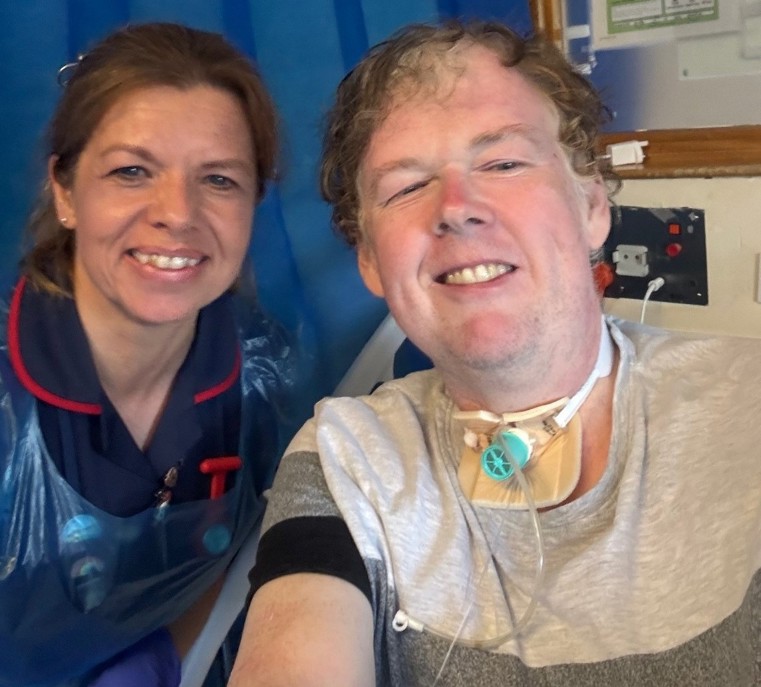
I consider it a privilege to collaborate with this patient group. Their needs extend far beyond the tracheostomy itself; they must adapt to life with an altered airway and navigate the challenges it introduces into daily living. This requires a truly holistic approach, as their body image, confidence, and psychological wellbeing can all be impacted.
I take great satisfaction in helping to improve their quality of life and found the opportunity to design and develop a new service both rewarding and deeply motivating, focusing on improving patient safety and outcomes, providing continuity of care, and establishing improved education.
As a Tracheostomy Nurse Specialist, what are some of the biggest challenges you see in the day-to-day management of Tracheostomy patients?
Ensuring patient safety in the community remains one of the greatest challenges in this role. Every individual requires a personalised care plan and a detailed tracheostomy passport. Securing ongoing funding for essential supplies can be difficult, particularly as funding streams for consumables are often unclear or inconsistent. This burden can, however, be reduced by supporting patients to register with an appropriate supplier, of which a small number are available.
As highlighted in the National Confidential Enquiry into Patient Outcome and Death report On the Right Trach? (2014), one of the persistent issues is the lack of sufficient knowledge and training across the wider healthcare sector. I have been working closely with the Ambulance Service and, more recently, with our local University, after identifying that altered airways are not adequately covered within the BSc (Hons) Paramedic Science curriculum. We have now run some simulation-based training for year 3 students and hope to make this an ongoing feature within their programme. This gap is recognised nationally and raises concerns regarding safe emergency management in the community. It remains a significant ongoing challenge and one that requires continued attention to address this effectively.
Another major challenge is identifying an appropriate discharge destination for patients leaving hospital. Facilities capable of supporting the complex needs of this patient group—particularly nursing homes equipped for altered airways and ventilated patients—are extremely limited. A substantial part of my role has been supporting a local nursing home in developing into a complex care unit, enabling it to safely accept patients with altered airways as well as those requiring full life-support ventilation. This has required considerable time, education, and ongoing competency support to ensure staff remain confident in both routine care and emergency response.
Maintaining strong multidisciplinary team involvement after discharge is essential to ensure patients are reviewed regularly, especially those who may show improvement and become candidates for decannulation. I have seen some remarkable success stories, including patients decannulated after living with a tracheostomy for many years. My motto remains: never say never.
What aspects of tracheostomy care do you feel are most important for the wider care team to consider?
When reviewing a patient with a tracheostomy, it is essential to begin by establishing the original indication for the tracheostomy. Understanding why it was placed allows you to determine whether that need is still present and whether there may now be potential to initiate weaning.
Maintaining good oral hygiene and dentition is particularly important, as both reduce the risk of chest infections and significantly influence a patient’s suitability for successful weaning. Effective secretion management is also crucial, ensuring that sialorrhea is well controlled and that the patient is receiving appropriate artificial humidification.
Ongoing assessment is required throughout the patient’s recovery to confirm clinical readiness for weaning and to identify changes that may support further progression. A strong multidisciplinary team approach is vital, with regular reviews to identify patients who may be suitable for decannulation. Access to Fibreoptic Endoscopic Evaluation of Swallowing (FEES) is particularly valuable in assessing upper airway function and informing safe decision-making.
One of the most significant lessons I have learned is the importance of supporting effective communication from the outset. Where appropriate, initiating a one-way valve trial as early as possible can greatly enhance a patient’s ability to communicate and can have a meaningful impact on their overall wellbeing.
What resources are available, particularly for community care professions, to help healthcare workers?
Each patient should have an individualised care plan and a tracheostomy passport, along with an emergency tracheostomy box. The passport should outline all the relevant discharge information and current care recommendations alongside aspects that have been tried, ie, weaning attempts/previous tubes, etc.
A working group of specialists nationally, alongside some key stakeholders, has developed a Principles of Care document for patients living with a tracheostomy within the community setting. This resource outlines best practices to support consistent, high-quality care across services. This was primarily created to address the knowledge gap and serves to drive improvements in care for this vulnerable group.
The NTSP website also provides 6 eLearning modules covering different aspects of tracheostomy care. While the content is focused on the acute setting, it remains a valuable educational resource for all clinicians involved in tracheostomy management.