Trees reflected in buildings

Examples and inspiration

Here you will find examples of sustainability problems you may face in workplace and some ideas on how to solve them.

You can also read case studies that are not specific to respiratory medicine, but which could be adapted on the Centre for Sustainability website. These include pathway change, food waste reduction, walking aid reuse and reduction in procedural waste. 

QIP Ideas: real world high quality, low carbon care initiatives

Use the Plan – Do – Study – Act (PDSA) cycle

  • View a PDSA worksheet from the IHI.
  • Use the SusQI resources from the Centre for Sustainable Healthcare
  • Use SMART goals (specific, measurable, achievable, relevant, time-bound)
  • Consider environmental, financial, and social impact (the triple bottom line)
  • Track change and celebrate success
  • Get support from your Trust’s QI or Green Team

The pitch

Inhalers, specifically MDIs, contain propellants which are potent greenhouse gases. Inhalers contribute 3% of the NHS carbon footprint. There is significant variation in MDI vs DPI prescribing across the UK and internationally. In the UK we prescribe many more MDIs than Europe (70% vs 50%). In Sweden they only prescribe 15% MDIs. Our outcomes for COPD and asthma are not better, and in many cases poorer. This tells us we need to give more attention to using the right device for every patient, and provides an opportunity to reduce the environmental impact of inhaler prescribing.

Timeframe: 10 months

Plan

  • Identify key collaborators: pharmacists, including EPR pharmacist, Trust QI team, respiratory trainee doctors and consultants
  • Establish baseline inhaler prescription data, analysed by device type and carbon footprint (see PrescQIPP for inhaler carbon footprint data). 

Do

  • Assess healthcare professional knowledge/ confidence using questionnaire
  • Switch from Ventolin (high volume therefore higher CO2e per puff) to Salamol (low volume propellant) as default MDI SABA.
  • Remove inhalers using the highest CO2e HFCs (HFA227ea) from formularies/stock and replacing with suitable alternatives.
  • Prioritise new low carbon MDIs as they become available eg Trixeo
  • Teaching sessions, posters/leaflets, updating guidelines, increasing the ward stock of dry powder inhalers (DPIs), changing the default EPR dropdowns to DPIs rather than MDIs, shared decision-making tools to support patient conversations.

Study

  • Number of high carbon inhalers issued 
  • Proportion of MDIs vs DPIs prescribed each month on respiratory/acute medical wards/ ED
  • Overall greenhouse gas emissions from inhalers

Key messaging

  • Whilst many patients have better technique with a DPI, there are some who require or prefer an MDI and the best inhaler choice is always the one the patient can and will take.
  • Every patient contact is an opportunity to review and optimise inhaler technique.


Examples of success

Practical tips 

  • Engage your Trust QI team to help with measurable outcomes and run charts before starting.
  • Be prepared for setbacks as local and national inhaler stocks fluctuate. 
  • Always assess inhaler technique and incorporate patient preference.

The pitch

SABA overuse is both a clinical and sustainability problem. Reducing SABA overuse is the best example of how high quality patient care is also low carbon care.

Timeframe: 18 months

Plan

  • Key collaborators: respiratory network, asthma lead, GPs with specialist interest in Respiratory care, pharmacists, ICB colleagues.
  • Baseline data: analyse primary care medical records to understand the extent and predictors of SABA overprescribing (available from ICBs)

Do  

  • Guideline Implementation: Develop and implement local prescribing guidelines to reduce SABA overprescribing.
  • Healthcare Professional Training: Provide training for healthcare professionals on the risks of SABA overuse, the benefits of alternative treatments and how to identify patients appropriate for a switch.
  • Patient Education: Educate patients on the importance of reducing SABA use and promote adherence to asthma management plans. Employ a shared decision approach when advising on a change to SABA-free.

Study

  • Number of SABA inhalers issued (month by month comparison)
  • Inhaler cost / patient
  • CO2e of SABA prescriptions /1000 patients
  • Patients issued >4 SABA a year
  • % patients on a SABA-free regime (AIR/MART)
  • Exacerbation rate / ED attendances with asthma

Key messaging

  • SABA overuse is a major risk factor for poor outcomes in asthma, including death.
  • National and international guidelines recommend SABA free regimes first line for appropriate patients.
  • Since 70% of MDI inhalers dispensed in the UK are SABA, reducing overuse has great potential to reduce CO2e from inhalers without having to switch any devices.


Examples of success

Practical tips

  • Engage your Trust QI team to help with measurable outcomes and run charts before starting.
  • Be prepared for setbacks as local and national inhaler stocks fluctuate. 

The pitch

Gloves are a huge source of single use plastic in healthcare, and reducing unnecessary glove use has health, environment, and financial benefits (improved hand hygiene practice, reduced single-use plastic, and reduced cost).

Timeframe: 10 weeks (single ward)

Plan

  • Key collaborators: Infection Prevention and Control Nurse, ward manager, Ward sisters, Communication team, procurement, ward healthcare support workers, porters, ward catering staff.
  • Baseline data: glove use (procurement data), handwashing audits, current trust guidelines (eg iv medication dispensing guidance) staff knowledge of guidelines, staff beliefs around hand hygiene and glove use.

Do 

  • Leadership engagement, Posters (no risk, no glove), Trust-wide videos, ward champions
  • Snapshot hand washing audits
  • Patient/staff surveys

Study

  • Glove use, environmental impact (calculated using CO2e emission factor for each glove), economic and social impacts, plastic waste 
  • Cost of unnecessary glove use
  • Excess plastic waste, CO2 equivalent emissions given carbon emissions of each glove

Key messaging

  • Only unnecessary glove use is being targeted. More glove use will be appropriate in some areas (eg RSU, trache care).
  • Good hand hygiene is more effective than glove use for reducing cross contamination in many circumstances.

Examples of success

Practical tips 

  • Start with a short achievable time frame, with longer term goals.
  • Ensure that guidance on glove use is clear and consistent from all sources eg posters on ward, infection control policies, medication preparation guidance.

The pitch

Antibiotics are often given as liquid in children when they could be tablets. Liquid is high cost, high carbon, high waste compared to tablets.

The project

The Kidzmed project was developed to help children and young people learn how to swallow tablets, using a simple six-step technique.


The pitch

Pressurised metered dose inhalers (pMDIs) carry a significant carbon footprint — a single ventolin inhaler is equivalent in emissions to driving 175 miles.* In departments where only a limited number of puffs are required per patient (such as reversibility testing in spirometry or burst therapy for viral-induced wheeze), inhalers have historically been disposed of after a single patient, wasting the majority of the medication. 

The project

Cleaning inhalers to allow multiple patient use at University Hospital Southampton NHS Trust.


Examples of problems

You recently came across the concept of lean pathway in healthcare by reading the BTS Position Statement on Sustainability and the Environment: Climate Change and Lung Health 2024

Today a patient came on hospital transport for assessment in the general Respiratory clinic. Their lung function appointment is not until next week which will require another visit to the hospital. The patient has hearing issues and has requested in-person rather than telephone appointments so they will need to return a third time to discuss results. 

You think a lean pathway approach could help this issue of multiple appointments leading to waste of both resources and patient time.

How can you identify key interested parties? 

  • Brainstorming: Discuss your idea of lean pathway for clinic patients with colleagues/line manager/department lead and plan a QI approach. Identify a list of people that should be engaged for this project e.g respiratory clinic administrator, lung function booking team, clinic secretary, consultants, head of department etc. Discuss your idea with each of them to identify more people who could influence your pathway.
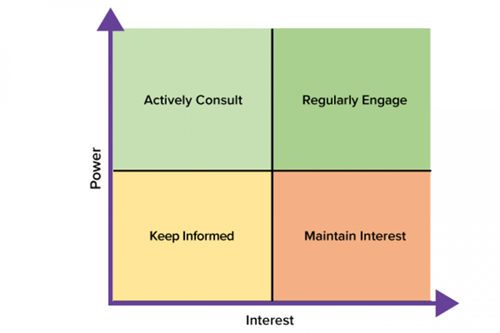
  • Mapping of key players:. It can be useful to map your list of people using the Mendelow’s power-interest matrix (this process is also known as Stakeholder mapping). This helps to determine who is essential to meet as the core team, and who can be kept updated, making it easier to find times when key people can meet and maintain momentum. 

Power and interest grid


Definition

Example

Actively consult

These are your interested parties that can help you deliver the project. These may be people that the change will affect, or those that have influence to deliver the change.

Respiratory clinic administrator, lung function admin team, lead for lung function department

Regularly engage

These could be people that the change will affect but do not want to deliver the change, or people of influence that can guide the project.

Lead QI consultant, head of department, patient transport representative

Keep informed

These are people that need to know the information and will be useful in rolling out this change, but may not be actively involved in delivering.

Other Consultants and specialist nurses/physios/AHPs who deliver clinics

Maintain interest

These are usually people that are interested in the change but may not be involved or influential in delivering. It could be someone that won’t be affected by the change but would be interested in delivering something similar. 

Department manager, other Respiratory team members, patient outcomes/quality team 

You have undertaken a QI project to reduce the plastic waste produced by respiratory procedures in your department. This involved engaging multiple interested parties, identifying potential areas of improvement and making some fundamental changes to the usage of equipment for each procedure. You need to keep everyone involved in the project updated on the status of your project and the impact of your greener approach to sustain the benefits of your intervention.

How to measure and report impact to the interested parties

Depending on the purpose and audience, different measures and ways of communicating will be effective. In all cases, think about how you can make it relatable to the audience. Using infographics and converting outcomes into more familiar measures can be very effective. Develop a clear and compelling message and focus on what your idea will improve (e.g. patient care, cost savings, efficiency, safety, or climate impact). Utilise multiple channels to communicate message- trust newsletters, internal intranet, posters, powerpoint slides, podcasts, videos

Give examples of things that can be done that lead to environmental impact such as:

  • if you replace x miles in a car by an electric bus or bike you will save x
  • If you reduce your red meat consumption by x, your risk of cardiovascular disease will reduce by x and also you are reducing the emission of greenhouse gases by X

Use Key Performance Indicators (KPIs): simple measures can be very powerful eg

  • kg reduction in plastic waste or carbon footprint per procedure
  • cost savings of your intervention over a year.

Reporting the status of your project

For more complex projects, you can use an Environment, Social and Governance framework (ESG) or NHS sustainability reporting frameworks.


You are leading a Gloves off QI project in your respiratory ward. You have identified interested parties for your project at ward and departmental level. You are looking for ways of engaging these people and what resources you might need. 


How to engage interested parties in your project? 

  • Engaging local team: use daily ward huddle to spread awareness among colleagues about your project, create posters for display in ward clinical areas to highlight ways to avoid excessive glove use and put up prompts near the glove boxes on your ward. Create opportunities for staff to ask questions and share concerns about the change you propose. Involve infection control team at all stages to ensure clear messaging on when gloves are/are not recommended.
  •  Engaging department/organisation: engage the staff through departmental teaching, staff emails or a newsletter. At an organisational level, you can present the findings of your QI project at a Grand Round or quality forum to raise awareness about your project and sustainability. You can join departmental meetings of other specialties to share your learning and support other teams to spread your success to create organisational change.
  • Engaging patients: As part of King’s College Hospital NHS Trust’s Gloves Off project, a patient survey was conducted on attitudes to glove use. This provided an opportunity to inform patients about the benefits of hand washing over glove use, identified specific patient groups who needed adjustments or additional information, and also reassured staff that many patients preferred staff not to wear gloves for many tasks.

Priorities for further research

Research is needed into trends in UK practice with regard to single-use bronchoscopes and laryngoscopes. Further comprehensive assessment of the environmental impact of single use versus reusable bronchoscopes is needed, following one study published in 2018 on this.

Any research needs to take into account known broader health impacts of plastic production and disposal, estimated to result in global health care costs of $250 billion each year.