

Green world held in someone's hands

The Climate Crisis: A Global Health Emergency

The climate crisis sits at the intersection of multiple interacting environmental crises. Global heating, biodiversity loss, air pollution, ocean acidification, extreme weather events, drought, wildfires, vector-borne disease, and climate-related migration and conflict, all pose a direct threat to health and wellbeing.

Respiratory health is at the heart of this crisis.

Environmental changes disproportionately affect the most vulnerable

Air pollution alone contributes to millions of premature deaths each year. Rising temperatures, degraded indoor air quality, allergen exposure, and wildfire smoke all exacerbate respiratory disease. These including lower-income communities and people with pre-existing respiratory conditions.


Areas of focus

As healthcare professionals, we have a duty not only to treat illness but also to prevent it, and that includes acting on the environmental drivers of disease. It can be difficult to grasp the sometimes abstract and seemingly distant threat of environmental crises. Communicating through the lens of health makes its impacts immediate and personal; when people understand that the air they breathe is affected, the urgency becomes harder to ignore.

Respiratory care itself has a disproportionately large environmental impact. Metered-dose inhalers are among the highest-carbon footprint medicines prescribed in the NHS. Hospital admissions also carry a large carbon and resource cost. This puts respiratory professionals in a pivotal position: we can improve individual and planetary health by changing how we deliver care.   

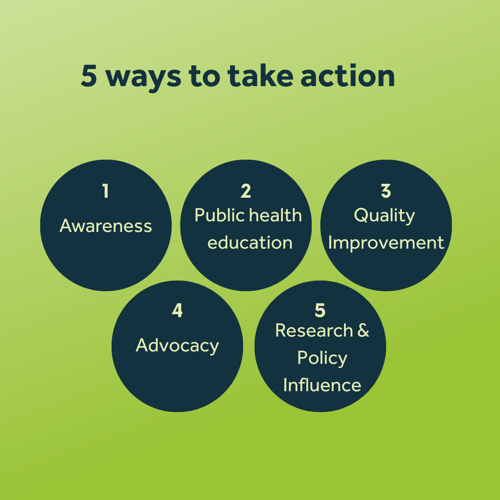
5 wyas to take action


  • Awareness: educating ourselves and colleagues, so we are equipped to communicate, influence and advocate for others
  • Public Health Education: informing our patients and communities about the health impacts of the climate crisis, and empowering them to reduce vulnerability
  • Quality improvement: designing and scaling interventions which reduce the environmental impact of healthcare delivery and facilitate adaptation to a changing climate
  • Advocacy: harnessing the power of the voice of the healthcare profession and leading the call for action to reduce climate change and air pollution
  • Research and Policy Influence: generating evidence to drive more sustainable practices and adaptation to change, and influencing those in power to ensure such policies are adopted and supported 

National strategies already require NHS organisations to reduce their environmental impact.

England: 

  • NHS England mandates net-zero emissions by 2040, with interim 80% reduction targets by 2028–2032.
  • Healthcare providers  are legally obliged to consider environmental targets in their decisions and follow ‘green plans’.

Scotland:

  • Aim for NHS Scotland to be net zero by 2040, with supply chains net zero by 2045, without reliance on offsetting

Wales: 

Northern Ireland

  • No specific NHS strategy

NICE

SIGN

Sustainable respiratory care delivers safe, effective, and equitable treatment while reducing harm to people, and planet. It recognises that every clinical decision—what we prescribe, how we deliver care, how we design services—has consequences that go beyond immediate clinical outcomes.
Fortunately, what benefits the planet often benefits patients too.

The four principles of sustainable respiratory care, as first described by Frances Mortimer can be summarised as 

  1. Preventing disease,
  2. Lean care pathways
  3. choosing low-carbon technologies, and
  4. empowering patients to self-manage their disease. 

These principles can all make care both higher quality and more sustainable.

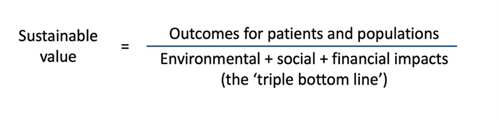
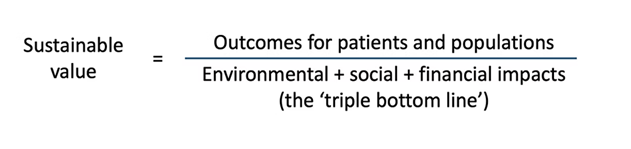
Sustainable Quality Improvement (SusQI) promotes a “sustainable value” approach to measuring improvements in healthcare. It weighs outcomes for patients and populations against:

  • Environmental impact – reducing emissions, waste, and resource use
  • Financial impact – ensuring cost-effectiveness
  • Social impact –loneliness, equity, staff wellbeing, and patient experience

Sustainable value promotion positive outcomes

This Sustainable Qi model challenges us to ask not only “Does this intervention work?” but also “Is it environmentally responsible? Is it socially just? Is it a good use of resources?”
 
For ideas and inspiration on actions see Turning knowledge into action.